
Salad may appear to be one of the simplest foods to eat, but a formal meal can reveal a surprising amount about your table manners. Loose leaves, slippery tomatoes, crumbly toppings and generous dressings all require a little care.
Whether you are dining at a wedding, attending a formal dinner or simply wishing to improve your manners at the table, knowing how to eat salad gracefully will help you feel more confident. The essential principles are simple: use the correct cutlery, take manageable mouthfuls and eat with restraint.
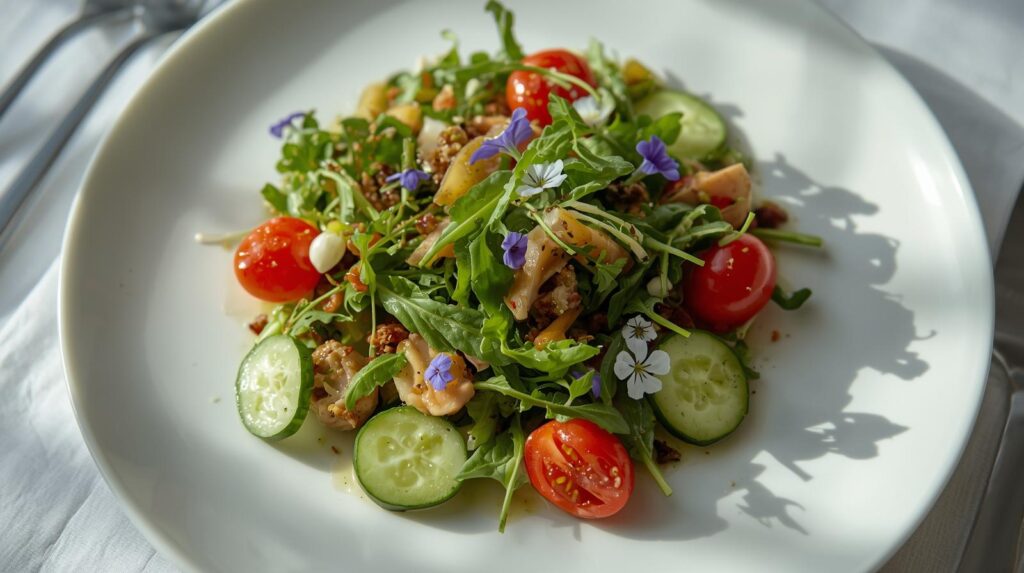
Use the Correct Cutlery
If salad is served as a separate course, use the salad fork provided. In a formal place setting, it is usually the outermost fork on the left, because cutlery is used from the outside in. If a salad knife is provided, it will generally be the outermost knife on the right.tastingtable+1
When salad is served alongside the main course, it may be presented on a separate salad plate. In many formal settings, this plate is positioned to the left of the dinner plate, beneath the bread-and-butter plate.jeannenelson
For a traditional British or continental style of dining:
- Hold the fork in your left hand.
- Hold the knife in your right hand when a knife is required.
- Keep the fork tines facing downwards.
- Use the knife to cut or guide food rather than to spear it.
- Do not change the fork from one hand to the other between bites.
If you are eating a simple salad that does not require a knife, you may hold the fork in your dominant hand. The most important consideration is that your movements remain controlled and comfortable.
Fork-Only Salad Eating
There is a long-standing tradition of eating salad with a fork alone. This is especially suitable when the leaves and other ingredients are already presented in manageable pieces.
A fork can be used to fold a large lettuce leaf, secure a piece of vegetable or gather several ingredients into one neat mouthful. With practice, it is often possible to eat salad without a knife, even when the leaves are slightly awkward.
However, etiquette should never require you to struggle. If a leaf is too large, a tomato is difficult to manage or several small ingredients are scattering across the plate, using a knife and fork is perfectly acceptable. Modern salads are often more elaborate than the simple green salads for which older conventions were established.
When to Use a Knife
It is entirely proper to use both a knife and fork when eating salad, particularly when the ingredients are large or difficult to control. This might include:
- Large lettuce leaves.
- Whole or thickly sliced tomatoes.
- Grilled vegetables.
- Avocado.
- Pieces of chicken, cheese or fruit.
- Grains, pulses or other small ingredients that need guiding onto the fork.
Use your fork to hold the food steady and your knife to cut it into a manageable piece. The knife may also gently guide quinoa, chickpeas, lentils or other small ingredients towards the fork.
Avoid cutting the entire salad into small pieces before you begin eating. Instead, cut only one or two mouthfuls at a time. This keeps the food looking attractive and allows you to eat at a natural pace.capital+1
Your knife should be a quiet supporting tool, not a shovel, scraper or weapon. Never use it to push food around the plate unnecessarily, and never bring it to your mouth.
Eat Neatly and Slowly
Salad should be eaten in small, manageable mouthfuls. Avoid attempting to fit an entire lettuce leaf or large piece of tomato into your mouth simply because it is already on your fork.
Long, ribbon-like leaves such as rocket, frisée or radicchio can be particularly awkward. Fold or cut them discreetly before taking a bite. A small pause is always more elegant than struggling with a leaf that trails from your mouth or catches against your chin.
Salad can also be surprisingly noisy. Lettuce may crackle, croutons may crunch and raw vegetables can make a noticeable sound when bitten. Keep your mouth closed while chewing, and avoid speaking until you have swallowed.
Good dining etiquette is not about eating unnaturally slowly. It is about taking sensible portions, keeping your movements calm and allowing conversation to continue comfortably around you.
Bread and Dressing
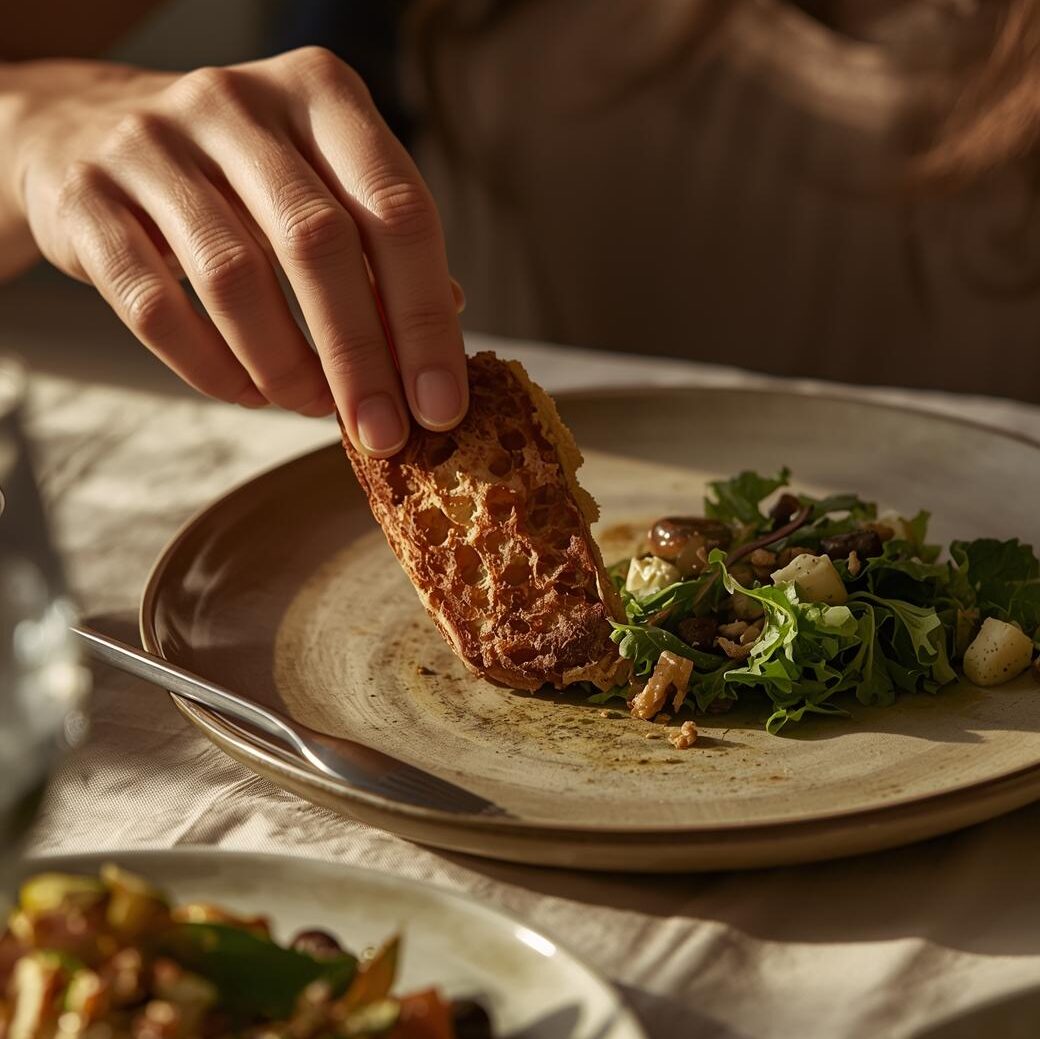
Bread should remain on the bread-and-butter plate to your left. If a roll or slice of bread is provided, break off a small piece with your fingers rather than cutting it with a knife.
If butter is available, butter each piece individually just before eating it. The piece should be small enough to eat in one or two bites.
Even if the dressing is delicious, do not use bread to wipe the salad plate. Bread is intended to accompany the meal, not to mop up vinaigrette or dressing. This is one of the details that separates relaxed everyday eating from polished formal dining etiquette.
Avoid Overloading the Fork
A salad fork is not designed to carry every ingredient at once. Select a modest combination of leaves and toppings, ensuring that the mouthful can be eaten comfortably.
Avoid:
- Balancing a precariously large mound on the fork.
- Spearing several ingredients aggressively.
- Chasing individual grains around the plate.
- Mixing every element into one untidy mass.
- Taking a bite that is too large to chew comfortably.
If a small ingredient is difficult to pick up, use the side of the fork or the knife to guide it gently into place. Do not use your fingers, even if the ingredient seems impossible to catch.
Resting and Finishing
When pausing during the course, place your cutlery on the plate rather than returning it to the table. In the continental style, the fork and knife may rest diagonally across the plate while you are still eating.
When you have finished, place the knife and fork together on the plate. The knife blade should face inwards, towards the fork. This quietly signals to the host or server that you have finished and prevents the cutlery from being removed prematurely.capital+1
Do not push the plate away from you. Leave it in its original position until it is cleared.

The Principles to Remember
Salad eating etiquette is easy to follow when reduced to a few practical rules:
- Use the salad fork, or the outermost fork, if one is provided.
- Eat small, manageable mouthfuls.
- Use a knife when leaves or ingredients are too large to manage with a fork alone.
- Hold the fork in the left hand and knife in the right when following traditional British etiquette.
- Keep your mouth closed while chewing.
- Break bread into small pieces and never use it to wipe the plate.
- Rest your cutlery on the plate when pausing and place it together when finished.
A simple salad can test your table eating etiquette more than an elaborate roast because its ingredients are often loose, slippery and uneven in size. Eating it well calls for patience, precision and consideration for the people around you.
The aim is not to make a meal feel restrictive. It is to eat in a way that allows everyone to relax and enjoy the food and conversation. With a little practice, even the most unruly salad can be eaten with confidence, grace and good manners.