
Your 5-step guide to neutralising social manipulators with style!

In the grand theatre of British social life, where the phrase “I’m awfully sorry” can mean anything from “I’ve accidentally spilt tea on the table” to “I’ve just broken an 18th century vase that you inherited from your great-grandmother”, there exists a peculiar psychological battleground. This is the place where stiff-upper-lip politesse meets cold, calculated self-interest.
The defining signal of this conflict? The beautifully understated, yet utterly loaded, sentence: “We shall trespass a little longer on your kindness.” This gem, as we recall, was delivered by the wonderfully anxious, strategically oblivious Mrs. Bennett to the amiable Mr. Bingley in Pride and Prejudice. And what could the gentlemanly Mr. Bingley possibly do? He simply felt compelled to say “yes”, thereby cementing his fate as the host for an indeterminate period.
The Polite Manipulation
This isn’t just a historical literary footnote; it’s a living, breathing, and frequently frustrating part of modern life. We are talking about the Polite Manipulator, the social operator who relies not on intimidation, but on your inherent, deep-seated fear of causing a fuss. They are the human equivalent of a passive-aggressive houseplant that slowly takes over the entire conservatory.
In British culture where an apology is often deployed as a punctuation mark rather than an expression of genuine remorse, and where asking for a favour often comes wrapped in three layers of self-deprecation, the manipulator knows exactly where your defences lie: your deep-seated aversion to being considered ‘gauche’ or rude.
However, it is hardly a uniquely British affliction. It is a truth universally acknowledged that as soon as you become regarded as very kind and polite, there will always be those trying to take advantage of you, be it in a direct or in a more subtle way (like the proverbial Mrs Bennett!). And I venture to suggest that the fact that you are reading this article now reflects that you may have encountered polite manipulators yourself.
We have all experienced this: a guest who had been invited for a cup of tea but hints at staying for dinner, another guest who asks you to give the remainder of the cake that you had served as a pudding to her children who adore that particular cake, a friend who always orders more than you do in a restaurant and suggests splitting the bill…
Here are my own experiences of the same phenomenon:

Case No. 1: A colleague, let’s call her Ivy, realising that everyone (except for herself) had thought of getting Christmas presents for team members, “generously” exclaims: “I’ll treat you all to prosecco over lunch!” The bottle is duly ordered, enjoyed, and the atmosphere is festive until the bill arrives. “Would you like me to divide it by 4?” the waiter enquires. Silence and polite nod from everyone, including Ivy. She hadn’t treated anyone. She had successfully leveraged the appearance of generosity to avoid the minor embarrassment of a forgotten gift, all while making you pay for your own ‘treat.’
Case No. 2: You innocently ask visiting family members, “Do you have any plans for tomorrow?” (A simple, conversational query, meaning precisely what it says: “I am genuinely interested in what you are up to, as I could recommend some nice places to visit.”)
The response: “We will come here!” (Meaning, “Your flat is now my destination, your polite question was an invitation, and your day is cancelled. Thank you for hosting!”)
The result: I felt I had to accept. Why? Because to decline felt offensively rude. A simple, polite conversation was flipped into an uninvited commitment, and my inability to say “No” was the weapon used against me.
This phenomenon isn’t malice, necessarily—it’s just effective, socially sanctioned opportunism. The manipulator banks on your fear of social awkwardness. They know you won’t point out the ‘maths error’ when splitting the bill, or state flatly, “No, you’re not coming over, I’m busy.”
The good news, however, is that you can, in fact, maintain perfect politeness, keep your reputation intact, and, crucially, neutralise these kindness trespassers by following a few simple steps.
1. Deploy the Polite, Pre-emptive Excuse
When an unwelcome commitment is thrust upon you, do not engage with the request directly. Refer immediately to a prior, unchangeable engagement. This must be done with an air of genuine regret and a dash of oh-the-hassle-of-it-all.
How to Handle the Outstaying Guest:
When someone is clearly angling to stay for two more nights, stretching your hosting duties (and dwindling tea supplies), you could say something like:
“Oh, Jack, I am so sorry, but I really can’t manage past Monday morning. I’ve actually got another friend staying with me from Tuesday onwards, and I might need the whole day to properly prepare/clean/re-stock the fridge, you see. You know how it is! I’m dreadfully sorry for the inconvenience.”
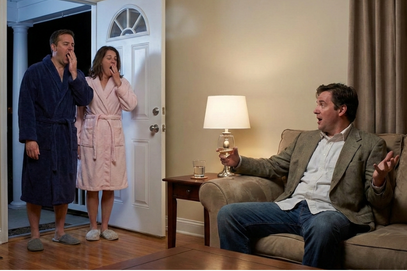
How to Handle the Uninvited Visitor:
Your family member has announced their impending arrival tomorrow, like they did in my case?
You may wish to say to them:
“Lily, that’s such a lovely thought, and it would be delightful to see you again, but, honestly, I am absolutely tied up tomorrow. I have to go to the office [or the dentist/a hairdresser’s appointment/the annual cleaning of the shed—it just needs to sound necessary]. I won’t be able to receive you, alas. However, I was just thinking—have you been to the British Museum? There’s an excellent exhibition about the Samurai there at the moment. You must go! And then we can catch up properly later in the week.”
By saying this you have immediately replaced the obligation to host with an alternative, more interesting (and crucially, not your problem) activity. You haven’t rejected them; you have simply regretted a scheduling conflict. This gives them a clear, polite exit strategy.
IMPORTANT POINT: Your excuses, whilst fictional if necessary, must be believable and external. Blaming a busy diary or a demanding commitment (like “the office” or “another friend”) is far more effective and less personal than simply saying “I need my space”.
2. Institute the “Watch List” (Future Proofing)
Once you’ve identified a recurrent trespasser, their name goes on a mental ‘Watch List.’ You’ve had your moment of being blindsided, but you won’t have another. Think of it like the old-fashioned way restaurants dealt with known ‘stowaways’ (those who left without paying)—they described them to fellow establishments so they could be easily recognised and denied entry. You apply this internal system to your social circle:

- The Phantom Treat Colleague: Make a solemn, unspoken vow not to have a meal requiring shared payment with them again.
- The Equal-Split Friend: If a friend consistently orders the lobster and suggests splitting the bill equally, you must speak up immediately, politely, and firmly: “Oh, could we perhaps ask the waiter to just itemise our orders separately? It would make the maths much easier, don’t you think?” (Again, framing it as an aid to simplicity, not a rebuke)
- The Outstayer: When discussing future visits, be pre-emptive. If they are family whom you cannot absolutely say no to, discuss and confirm all plans, including travel arrangements and departure dates, well in advance, leaving no room for ‘unforeseen circumstances’.
3. Erase the Great British Guilt Trip
This is, admittedly, the hardest psychological hurdle. From our earliest years, we are taught to be kind, accommodating, and, above all, to not cause offence. Refusal, even a polite one, often comes packaged with a hefty slab of guilt.
You must internalise this mantra: “You only have one life. You do not owe anyone unrestricted access to your time, your space, or your wallet.”
As long as your decline is wrapped in politeness, delivered with a smile, and, most importantly, does not (see point 4), you are not just in the right; you are being responsible. Protecting your own boundaries is not a selfish act; it’s a necessary one. They are trying to make you feel guilty for their own convenience; don’t take the bait. Your time is currency. Spend it wisely.
4. Use your emotional intelligence – don’t overdo it!
Having read the above, you may feel a righteous fire ignited—a sudden urge to make a fresh promise to yourself: “Now I will say a polite “no” to everyone who unexpectedly requests something from me”. Hold your horses! This entire framework is about discernment, not blanket hostility.
Most people who “trespass on your kindness” do so for self-interest, not out of genuine need. However, life does happen. There are moments when true, compassionate kindness must override the rulebook.
For instance, imagine the following situations:
Grief and Crisis: A friend staying with you receives a phone call informing her that her beloved cat was run over by a car and died. She is understandably devastated and desperately needs someone to talk to and a safe space to process her loss. So, she asks whether she could stay another night. Sending her packing, no matter how politely, would be unkind.
Medical Emergency: Your elderly aunt happens to be in your part of town doing her shopping and suffers a sudden, acute fit of hypertension. She calls you and asks if she can pop in, because her immediate need is rest, quiet, and perhaps urgent medical assistance, not a long journey home. Saying something like: “Actually, I was planning to do some pilates this afternoon” would be most inappropriate.

Unforeseen Calamity: Your friend is staying with you “between homes” and is informed, at the last minute, that they will not get the keys on the agreed exchange day, but the following day. Their alternative is an emergency hotel booking that would cost them an arm and a leg. Offering an extra night is a minimal inconvenience to you, but a massive financial and emotional relief to them.
The line is drawn between convenience and calamity. Extend genuine kindness where needed. Reserve your sophisticated refusal techniques for the habitual, low-level opportunists.
After all, a missed or delayed hair appointment is easily fixed and costs only money and time. A lost friend, a relationship damaged by a callous refusal during a genuine emergency, or the neglect of a relative in medical distress is a far higher, irreparable cost.
5. Most Importantly: Check Your Own Hat
Before you start casting judgement and compiling your mental list of social villains, you must, with rigorous honesty, analyse your own behaviour.
Do you ever ‘accidentally’ take a cab further out than everyone else and then suggest splitting the fare equally? Do you ever order more expensive things than other people and then suggest splitting the bill? Do you ever outstay your welcome?
You do not want anyone else to read this very article and to nod sagely, thinking: “Ah, yes, this is precisely how I must deal with them.”
Well-mannered people are a delight to be with, while manipulators are ALWAYS a tiresome burden. Use your newly acquired psychological armour to ensure you are the former, not the latter.
In Conclusion: You’re Off the Hook
There are many forms of psychological manipulation in the wild, from gaslighting to emotional blackmail. But the most frequent, and often overlooked, is the quiet, genteel exploitation of your good nature.
You are now equipped not just to identify the moment someone attempts to “trespass on your kindness,” but to parry the social thrust with a polite, firm, and entirely guilt-free counter-move.
Go forth and enjoy your space, your time, and a cup of tea!